Jim returns with Part 2 of his opus on the art of offensive line play. Another outstanding piece of work, Jim, and further evidence that o-line play is as complex an endeavor as attempting to play a game living chess with a herd of grumpy moose. To catch up, read part one if you missed it. Enjoy it, and be sure to tell Jim what a badass job he did below.
I’m back for more! Thank you for your great responses and questions to Part 1, and for actually reading it. And, No, I would never consider coaching Michigan’s offensive line, because I don’t want to take a pay cut and work 80 hours a week… I’ve never sat down and tried to put into words what a lineman does, and I can tell you that it’s a lot harder than it sounds. I hope I’m hitting the mark and giving you something that not only makes sense to the average fan, but also does justice to the artwork that is playing on the offensive line.
Part 2 is going to cover run blocking. Run blocking is a much different animal than pass blocking, and I consider it a “natural” action. You see, in my warped, cluttered mind, I divide football into “natural” and “unnatural” actions and tasks players are required to perform. “Natural” is synonymous with athletic; therefore, a natural task or action on the football field is an athletic action that most people perform at an early age with very little intervention or coaching. For example, drive by any field where kids are playing football and you will see them execute the “natural” actions of throwing (QB), catching (receivers), tackling (defense), and sometime blocking (offensive line) the opposing players. Now, understand by blocking I refer to it in its most rudimentary form; i.e. getting in the way of another person and pushing them backwards toward their goal line. But, I consider it to be as natural as throwing and catching, just with a lot more technique, size, and strength required from the big boys up front. The “natural” actions of run blocking are where it diverges from the “unnatural” actions of pass blocking. Pass blocking is based on some pretty simple logic, but it requires a lot of work and technique to execute properly, and is something I consider to be learned, rather than innate. I will get into more detail about pass blocking next week, but you won’t see a guy squatting, with his head back, butt down, and arms extended in front of a pass rusher in any pickup game in America. Guaranteed! (Whew! I guess this is my way of answering the question of whether run blocking or pass blocking is easier… It’s definitely run blocking!) Below, I’ll discuss footwork, helmet, hand and shoulder position, as well as a variety of blocking techniques commonly used.
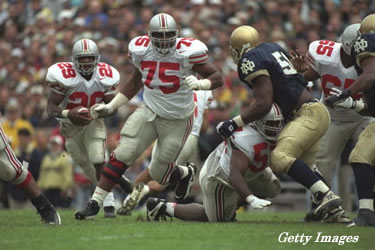
Orlando Pace on the loose. Mmm, pancakes.
Run blocking technique
The Drive block
We’ll start with the most basic block; the drive block. A drive block is the technique used to move a defender who’s lined up directly in front of you, or who may be shading to the left or right.
Footwork
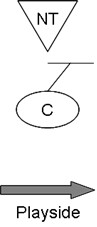
As I covered in Part 1, footwork is the single most important predictor of success for a blocker. It puts the lineman in a position of advantage, and allows him to control the defender. It’s very important that the first two steps gain ground up the field, and put the blocker in a position to be successful against the defender. There are some cases, however, when it may be necessary for the first or second steps to be lateral, instead of up the field. But, as a general rule, when run blocking the first two steps are up the field. First, think of a center, who’s covered by a nose tackle close enough to smell his rancid breath, and hear his labored mouth-breathing. If the NT is playing “heads-up”, meaning
directly in front of the blocker and not shading to the left or right, then the technique for the blocker is to take a 12-18” step with the play side foot, at about a 60-70º angle up the field. The second step with the backside foot should be the same distance and angle as the first step, and should happen immediately after the play side foot makes contact with the ground.
Helmet position
Where the head goes, the body will follow. Therefore, the position of the blocker’s helmet is very important in determining the success of a block. (more…)