WHAT HAPPENS TO COLLEGE FOOTBALL PLAYERS, PART ONE.
Paraphrasing Brian during what he called our “heated” discussion on SEC recruiting practices: what does happen to the guys in an SEC recruiting class (or by extension, any college football recruit pool) who sign a letter of intent but don’t complete their full term of eligibility? “They’re probably not going to Harvard,” was Brian’s quote.
A transfer to Bethune-Cookman may not be Harvard…but their band whips the Crimson’s ass.
Well, if they’re not joining the melange of cash-bleeding legacies, genuine braniacs, and token Hollywood admissions on famous scholarships at dear old Harvard, where do football recruits who sign letters of intent end up if not at Senior Day holding mom’s hand in front of eighty thousand witnesses?
We looked at Florida’s ‘02 and ‘03 classes to outline the eccentric, unpredictable, and as often equally mundane fates of [NAME REDACTED]’s prize recruiting classes. Real life and a modicum of research will always upset your assumptions, and this was no exception to that rule.
Class of 2002: 21 signees.
Not a jumbo-sized class by any stretch of the imagination for Florida. (Tennessee signed 87 recruits this year in comparison. Look it up-it’s in the Bible.) We’ll begin by counting the players who actually finished their eligibility, a different concept than “graduated,” mind you, but for simplicity’s sake we’ll leave it there for now.
Remember: this is more about how many scholarship athletes will actually get their four years of commitment honored, and not about graduation rates since we’re trying to get a quick-slice look at how scrupulous or unscrupulous a university is being by offering large numbers of scholarships to academically sketchy kids. (And there are a few in here, by the way.)
Guys who actually finished eligibility:
Nick Brooks: Finished eligibility. Never really made an impact of any sort.
Jemalle Cornelius: outstanding slot wideout on national champs.
Brian Crum: Half-time starter as linebacker. Bit underwhelming, but certainly looked like a football player:
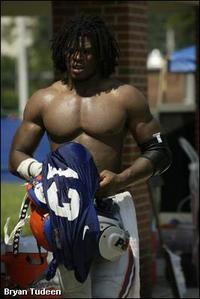
Steven Harris: finished as role player on defensive line. Entering NFL draft, and should: skills also include fathering children by multiple women at the same time.
Reggie Lewis: CB on national champ team, though almost transferred in Meyer/[NAME REDACTED] lurch.
Jermaine McCollum: finished.
Tremaine McCollum: finished.
Ray McDonald: oft-injured, but still saw significant playing time in career.
Kenneth Tookes. Known for his holding skills, mired on the bench as an nth-string wideout. Also discharged Dee Webb’s AR-15 in an apartment complex.
Deshawn Wynn: our national championship running back. Problem with carbs.
Transfers:
Patrick Dosh: Became a pirate at ECU. Yarr for him.
McKenzie Pierre: Robbed Florida fans of an exceptional name by transferring after ‘04.
Jimtavis Walker: Became a cabbie-mugging Beaver before flunking out completely.
Left for NFL:
Channing Crowder: starting LB for the Miami Dolphins.
Ciatrick Faison: RB, Minnesota Vikings. Top-shelf running back for mid-rank Gator teams.
Randy Hand: OL, Buffalo Bills.
Guys who left the team due to “excessive personality.”
Taurean Charles: displayed lack of understanding at the concept of a “win-win” situation by knocking someone off a deck at a party and then trying to crush said someone’s head with a half-full beer keg. Booted and finished career at Bethune-Cookman. Will likely be drafted.
Warranty expired (medical hardship):
Terrance Holmes: likely starter at safety out with shoulder injury. Unclear on status.
Guys who fell off the face of the earth.
Todd Bunce. D-lineman who fell into Federlineville.
Gavin Dickey: Fleet qb who opted to play British women’s sport instead of football.
Ryan Carter, OL: Running guns in Cote d’Ivoire, for all we know.
Summary: The breakdown:
-12 players who finished full term or took flyers to the NFL, both examples of “things that are supposed to happen to college scholarship offerees.”
-3 transfers.
-1 “O! Cruel fate!” injury case.
-1 gone due to extracurriculars.
-3 who met undetermined fate due to dropout, washout, or exciting opportunity in telemarketing industry.
If we’re pursuing the comparison that Delany rolled out in his letter, we’d square this with Ohio State’s 2002 team. Yet in academic profile, the closest parallel would not be Ohio State, but rather Michigan. (Save the comments: Michigan’s a better overall school academically. But we’re talking approximates, here.) Line the two up using Mike Desimone’s handy Michigan database, and we’re talking surprisingly similar numbers-and that’s using one of [NAME REDACTED'S] classes, which weren’t pulling the best fish from the net academically.
Florida: 21 signed. 9 finished. 3 to NFL. Remainder transferred, injured, or unable to contain joie de vivre.
Michigan: 20 signed. 12 finished eligibility. No early departures, but two NFL draft picks after graduation. (Interesting difference there.) 8 transferred, injured, or unable to understand the “private” in private parts.
A rapid comparison, yes; but for two comparable programs in the Big Ten and the SEC, the recruiting classes of 2002 worked out in very similar fashion. We’ll quick cut a few more as the week goes on at the risk of straining our research ligaments, admittedly tight after months of atrophy.


1
Briliant analysis. This is why I’m reading EDSBS instead of finishing my basketball stories by deadline.
O! Cruel internets!
Comment by Newspaper Hack — February 22, 2025 @ 2:23 pm
2
Taurean Charles needs to dial it down a little
Comment by juanmiguel — February 22, 2025 @ 2:25 pm
3
I actually know the guy who got his face smashed by that keg. Poor, unlucky SOB.
Comment by Anonymoose — February 22, 2025 @ 2:35 pm
4
so how many of those UF players actually graduated?
Comment by BC Pat — February 22, 2025 @ 2:41 pm
5
Good question, but the answer isn’t quite what we’re looking for here. (This is allegedly the province of the NCAA’s APR, but we’re suspicious of it.)
The question is this: if SEC teams are signing 25-30 kids a year consistently, what happens to them in an 85 scholarship world? Are the kids tossed aside like shredded Kleenex? Or is the picture more complex than that?
Comment by Orson Swindle — February 22, 2025 @ 2:45 pm
6
Not a fan of baseball, I gather? I prefer football myself, but I did see Dickey live and in person at the CWS a couple of years ago… (it was tremendously satisfying, if a bit nerve-wracking, to sit in the middle of twenty thousand Nebraska fans while UF destroyed their hopes.)
Comment by peachy — February 22, 2025 @ 2:46 pm
7
I suppose cuts have to be made, orson, just like in ncaa football on playstation. You guys can’t help it if the recruits all buy the “Program Prestige” pitch in week 1 and sign with you right away.
Comment by BC Pat — February 22, 2025 @ 2:48 pm
8
We never DO get that five star fullback, though. The bastard always signs with OSU.
Comment by Orson Swindle — February 22, 2025 @ 2:49 pm
9
As a female respondent I would like to thank you for that picture of Brian Crum.
Comment by zzgator — February 22, 2025 @ 3:03 pm
10
He was good for more than football skills.
Comment by Orson Swindle — February 22, 2025 @ 3:07 pm
11
Zook was able to keep one in school every now and then. Recruiting is very hit and miss.
Remember, even a clock that doesn’t run is right twice a day.
Comment by Senor Willy — February 22, 2025 @ 3:15 pm
12
Balance Dept:
I thought this was a he-man college football site. How about some equal time and display pictures of something like this:
http://www.trojanwire.com/football/si-swimsuit-models-meet-the-greatest-marching-band-in-the-history-of-the-universe.php
The second picture is particularly delicious.
Comment by Stacy Keibler Loves Me — February 22, 2025 @ 3:24 pm
13
Orson,
I’m not sure what you are trying to prove here. Here is what Brian said “You cannot consistently sign 28 player classes without regularly discarding players before their time is up, and where do these guys go once you throw them overboard? I’m guessing the answer is not Harvard.”
The math is true, and given the generally relaxed admission standards (both at UF and UM) the Harvard bit is true also.
As you know, 85 scholarships is the limit. There is no way to make 28 x 4 = 85. It is going to be 112 every time. Thus to sign 28 players 4 years in a row, a school has to obtain 27 players’ scholarships (this, of course, is not even considering the effect of redshirts and a fifth set of recruits).
If, on average, a school signs over 21.25 players annually it must have attrition. The more oversigning the more attrition. Brian’s point is that more attrition is not a good thing. I don’t think he meant to say that no attrition occurs at Big 10 schools.
Comment by maskedavenger — February 22, 2025 @ 3:30 pm
14
Figuring out whether the nature of the attrition is the point. Right now, we’re quick-slicing between comparable schools. (And not just Big 10/SEC, either. They’ll be others.)
How those kids are cut from the roster matters here. That’s what we’re trying to find out: how promising recruits don’t pan out, and if there are regional trends.
Clarified?
Comment by Orson Swindle — February 22, 2025 @ 3:39 pm
15
Yes. Although I doubt you can acquire the data, it would be interesting to see what % left in good academic standing.
Comment by maskedavenger — February 22, 2025 @ 3:41 pm
16
The interesting cases will come with something like Tennessee, which from 2002-2005 signed something like 96 kids. That’s more than 85 by a long shot. What happened to them?
Tomorrow.
Comment by Orson Swindle — February 22, 2025 @ 3:44 pm
17
Academic standing? That’s assuming programs care about graduation. Let’s not leap that far. Let’s just see how many actually honor the full term of scholarship.
Comment by Orson Swindle — February 22, 2025 @ 3:45 pm
18
I do think academic standing is a relevant concern for the following reasons. If a player leaves in good academic standing, then there is a stronger (though potentially rebuttable) argument that the transfer is the kid’s idea (likely chasing playing time). It also means that the school to that point has fulfilled its promise to educate the player while he is playing football.
But, again, I think that data would be very difficult to acquire. In particular, I think there is a federal statute which protects student privacy.
Comment by maskedavenger — February 22, 2025 @ 4:01 pm
19
Again, it’s supposedly included in the APR. It’s certainly important if you want to validate the concept of “student-athlete.”
We’re jaded, and therefore just concerned with who actually holds up their end of the bargain scholarship-wise.
Comment by Orson Swindle — February 22, 2025 @ 4:07 pm
20
maskedavenger:
Your math is perfect, but because Brian said that schools sign 28 recruits a year does not mean that it is so. My understanding is that a school may have 85 players, maximum, on scholarship at any given time. If Florida only had 21 to give in 2002 (and I don’t know that to be true), then their class met the (then-current) need. (And, as you well know, 21 x 4 = 84.)
The fact that attrition occurs is not disputed by anyone. It’s the reasons for attrition that are important; attrition by transfer or injury or failure to meet team rules versus attrition by academic inadequacy versus attrition for the sole purpose of opening more scholarship spots for more-promising players.
Orsons’ investigation is an interesting exercise in and of itself; the SEC versus Big 10 part of it notwithstanding. It is the stories behind the attrition that make the investigation worthwhile.
Comment by (Not Bama) Buck — February 22, 2025 @ 4:08 pm
21
Your analysis is great, and it is disturbing the number of recruited players who will not be getting scholarships/lose them later on. But we’re not even considering the factor of walk-ons. Those inflate program sizes, and some of them ultimately do get scholarships.
And maskedavenger, you’re right, it’s called the Family Education Right to Privacy Act (FERPA). The amusing thing about FERPA is that if someone asks you why a student is ineligible for something, you can’t answer the question if it’s academic related, which basically tells everyone it’s academically related. I’ve had that conversation a few times with other people…
Comment by Steve — February 22, 2025 @ 4:23 pm
22
Why do we need facts and figures to dispute? What happened to ole’ fashioned, unconditional hatred like:
Fuck the Big 10, Big 12, ACC, PAC-10, MAC, WAC, and everybody else who isn’t in the SEC!! WOOOO!
Comment by Aerobab — February 22, 2025 @ 4:25 pm
23
Isn’t the limit on recruits per year 25 unless you have a kid who enters early and can be counted against the year before if there’s room in that class? so by signing 28 kids, there’s either 3 off the bat that don’t qualify per NCAA standards or you end up with scholarships being pulled a la Steve Slaton at Maryland.
Comment by NDTom — February 22, 2025 @ 4:25 pm
24
We think that’s correct, NDTom.
One other consideration: “sign and send” guys who go to Hargrave Military or another JUCO count against the total number of scholarship slots.
Comment by Orson Swindle — February 22, 2025 @ 4:30 pm
25
What’s the correlation between Fulmer Cup points and attrition? I’m sure there’s a chart here somewhere…
Comment by Earl Schlobodowicz — February 22, 2025 @ 4:31 pm
26
I enjoy this debate. The main problem I have with the “Big Conference” comments re: the SEC is the sense of smugness and condescension when this occurs everywhere. Signings can develop in many ways. I am sure none of you are unaware that many coaches will sign kids who are not projected make it academically becaue it gives you a leg up on the kid when he comes out of Junior college. Another thing you don’t see as often, but Shula used alot to deal with scholarship reductions is the Grayshirt whereby a kid signs a letter of intent, but doesn’t become a full time student until the next spring so that he won’t count against scholarship number, yet can be studying the playbook and working out independently. This player will then join the team is sophmore year of college, but is still a freshman in eligibility.
What I am trying to say it that signing over 21 players a year does not always come out to be more than 85 in practice. Furthermore, offering the scholarship and the opportunity it entails should not be construed as reckless on the universities part.
It is, after all, the players responsibility to not kill a man with a beer keg.
Comment by Kecalf Bailey — February 22, 2025 @ 4:38 pm
27
Whatever, that kid deserved a keg to the head. He was a douchebag.
Comment by italiangator — February 22, 2025 @ 6:26 pm
28
Was Turean Charles aka: the kid who used half a keg as a blunt object, the same one who had the documentary made about him and his team? I believe it was called Year of the Bull.
Comment by amac42 — February 22, 2025 @ 7:45 pm
29
“Steven Harris: finished as role player on defensive line. Entering NFL draft, and should: skills also include fathering children by multiple women at the same time.”
Alright, cut the uptight analysis about schollies…what about ‘magical’ Steven Harris? How many dicks does this guy have? or is this another sad case of a misplaced prepositional phrase?
Comment by NoVaDamer — February 22, 2025 @ 8:11 pm
30
italiangator,
You’re right. I don’t know the kid, but generally if someone gets smashed in the head with a keg, he either deserved it or one of his friends deserved it. And he’s probably a douchebag for hanging out with people like that. However, having graduated from an SEC school, I am well aware that the football players often go picking a fight. So I really don’t know what I’m trying to say here. In any event, the kid was probably a douchebag.
Comment by Cardiac Kids — February 23, 2025 @ 12:45 am
31
amac42…yes, that is the same Taurean Charles from the documentary.
And speaking of Steven Harris, my neice had him sign her shirt after the NC celebration…perhaps I should not have let her get so close to such a fertile football stud.
Comment by zzgator — February 23, 2025 @ 9:57 am
32
Other than Rudy (or Rudie or Rudi), how many non-scholarship players do teams usually keep?
Also, if a kid signs a letter of intent, does that come with a promise of a scholarship or just a promise to try out? Aside from the Escalade and folding money, I mean.
Comment by SunDawg — February 23, 2025 @ 10:54 am
33
Ryan Carter suffered a career-ending injury (back).
Todd Bunce quit the team; I don’t think he transferred.
Gavin Dickey was a starting OF for the Class A Everett (WA) AquaSox, which paradoxically is a Seattle Mariners affiliate.
Comment by Give Em Hell Pell — February 23, 2025 @ 5:21 pm
34
I am glad to hear he is still performing!
You can’t knock a player for trying!!
He just want to play ball and make it like every body
else! I read the story and I know some one was out
to get him!!
Comment by ambrose — June 22, 2025 @ 1:04 am